
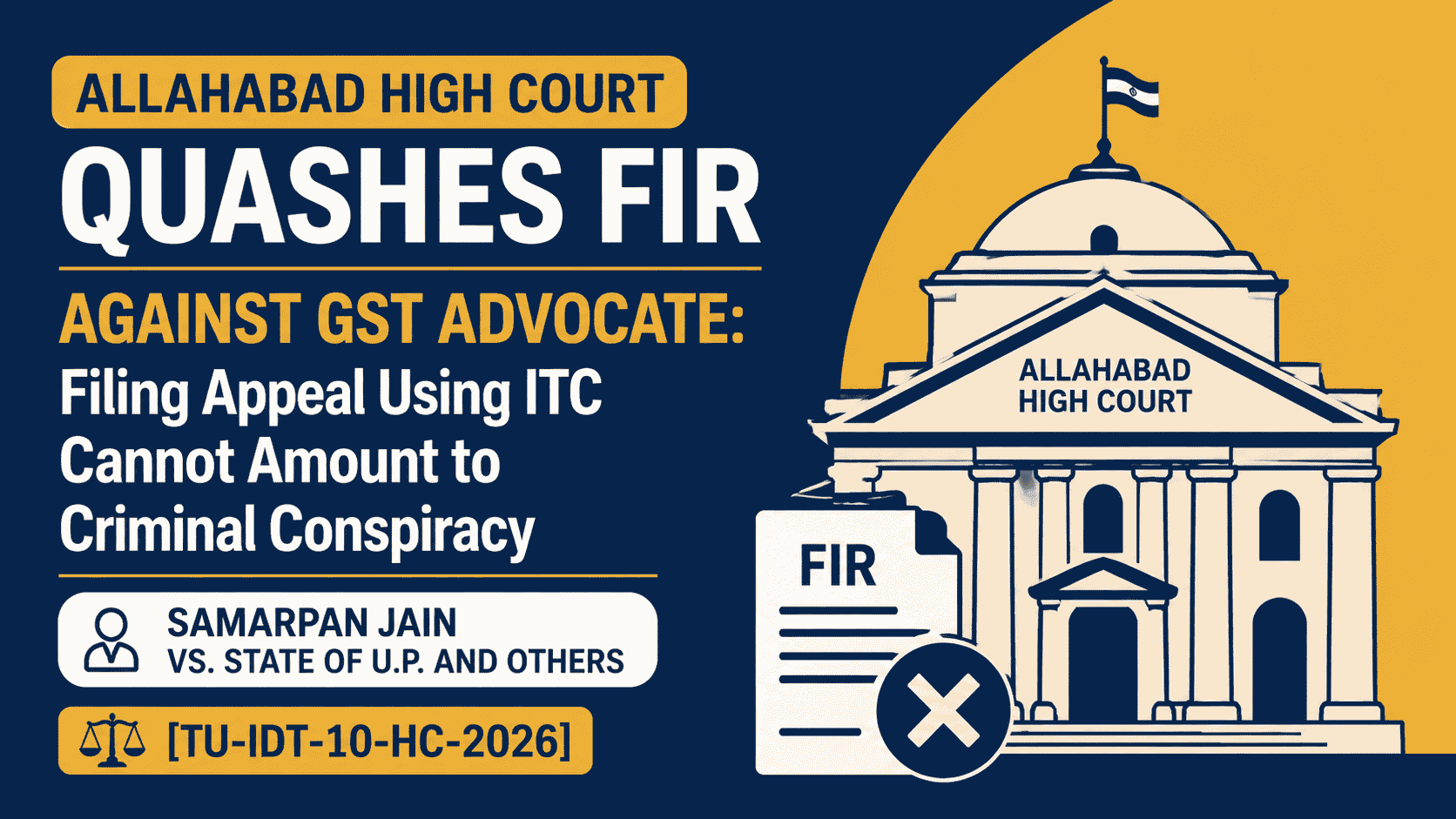

Samarpan Jain vs. State of U.P. and Others [TU-IDT-10-HC-2026]
Background of the Case
The present writ petition before the Allahabad High Court arose from criminal proceedings initiated against an Advocate practicing in indirect taxes and corporate laws. The petitioner, an Advocate enrolled with the Bar Council of Uttar Pradesh and also an Advocate-on-Record before the Allahabad High Court, had been engaged by his client to file statutory GST appeals under Section 107 of the CGST/SGST Act against assessment orders passed under Section 74 of the GST Act involving substantial tax demands for FY 2021-22, 2022-23 and 2023-24. While filing the appeals, the petitioner utilized the assessee’s Electronic Credit Ledger and Input Tax Credit for payment of the mandatory 10% pre-deposit requirement in accordance with CBIC Circular dated 06.07.2022 and relying upon the Gujarat High Court judgment in Yasho Industries Ltd., which had also been upheld by the Supreme Court.
However, the Appellate Authority rejected the appeals on the ground that payment of pre-deposit through Electronic Credit Ledger was not maintainable. Subsequently, instead of proceeding merely against the assessee, the GST Department lodged an FIR against both the assessee and the Advocate alleging criminal conspiracy, tax evasion and financial loss to the State Exchequer. During pendency of the writ petition, a charge-sheet and cognizance order were also passed against the Advocate, which were additionally challenged before the High Court.
Arguments by the Appellant (Advocate)
The petitioner contended that he had acted purely in his professional capacity while advising and filing the statutory appeals on behalf of his client. It was argued that utilization of Input Tax Credit for payment of mandatory pre-deposit was based on a bona fide interpretation of law supported by the CBIC Circular and the judicial precedents of the Gujarat High Court and the Supreme Court in Yasho Industries Ltd.
The petitioner further submitted that even assuming the legal interpretation adopted by him was erroneous, the same could never constitute a criminal offence or conspiracy with the client. It was emphasized that the petitioner had no business connection with the assessee and merely discharged his professional obligations as an Advocate. The petitioner argued that criminal prosecution of an Advocate for legal advice or procedural actions taken during representation of a client would strike at the very independence of the legal profession and adversely affect the constitutional right of citizens to obtain legal assistance.
Respondent’s Response (GST Department/State)
The GST Department defended the FIR by alleging that the assessee had wrongfully utilized Input Tax Credit for payment of the statutory pre-deposit requirement and thereby attempted to evade tax liability. The department alleged that such actions caused financial loss to the State Exchequer and were undertaken in conspiracy between the assessee and the petitioner Advocate.
However, during the course of hearing, the learned Additional Advocate General and the Deputy Commissioner of GST were unable to satisfactorily explain the basis on which the petitioner Advocate had been implicated in the criminal proceedings merely for filing statutory appeals and adopting a particular legal interpretation regarding pre-deposit through Electronic Credit Ledger.
Court Findings and Decision
The Allahabad High Court strongly deprecated the action of the GST Department and held that the FIR, charge-sheet and cognizance proceedings against the Advocate were wholly unsustainable in law. The Court observed that an Advocate, by virtue of his profession, is entitled to represent and defend clients fearlessly and independently, irrespective of the allegations involved against such clients. Merely because an Advocate adopts a particular legal position or files proceedings on behalf of a client, he cannot be treated as a conspirator in the alleged acts of the client.
The Court further observed that criminal prosecution of Advocates for professional acts performed during legal representation would strike at the very foundation of the legal profession and undermine the constitutional protections available under Articles 14 and 21 of the Constitution. The High Court specifically held that even if the GST Department believed that pre-deposit through Electronic Credit Ledger was legally impermissible, the petitioner’s action was still a professional act based on a particular interpretation of law and could never amount to criminal conspiracy.
Accordingly, the Allahabad High Court quashed the FIR, charge-sheet and cognizance order against the petitioner Advocate and held that continuation of criminal proceedings in such circumstances would amount to gross abuse of the process of law.
To download official order, Click Here
“The site is for information purposes only and does not provide legal advice of any sort. Viewing this site, receipt of information contained on this site, or the transmission of information from or to this site does not constitute an attorney-client relationship. The information on this site is not intended to be a substitute for professional advice.”