


New GST Rates 2025:
GST Council 56th Meeting Updates
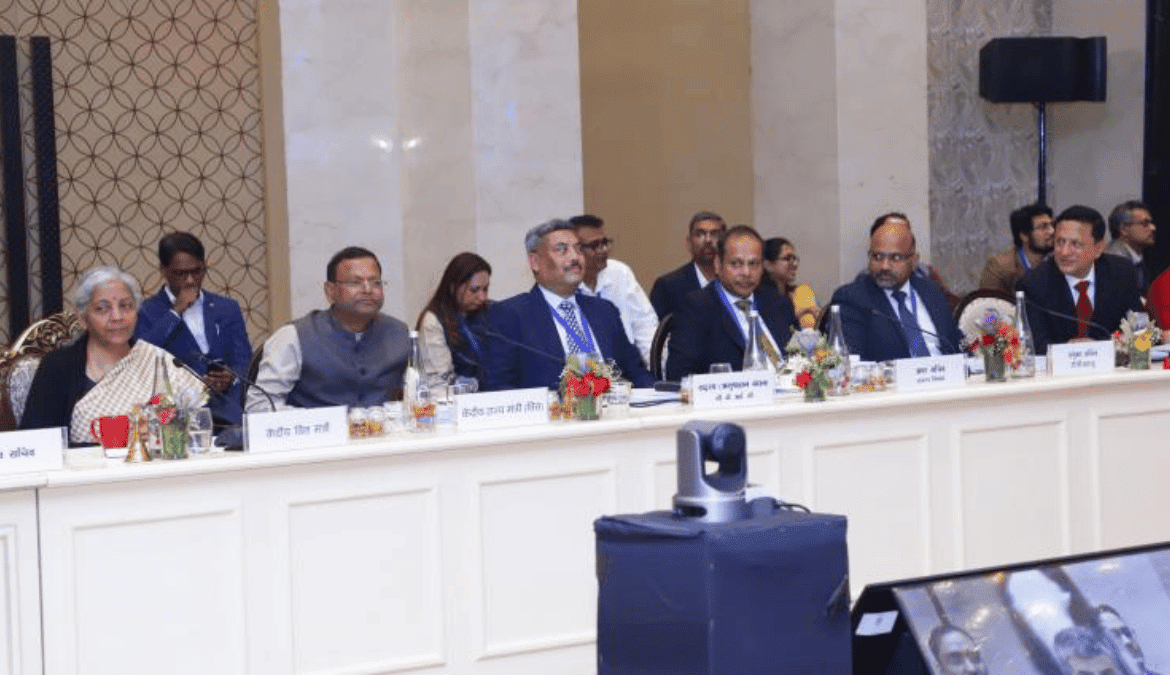
The 56th GST Council meeting, chaired by Finance Minister Nirmala Sitharaman in New Delhi on 3rd September 2025, introduced sweeping reforms to simplify India’s tax regime and provide relief to citizens. The focus is on lowering costs for the common man, rationalising tax rates, and boosting sectors like health, agriculture, and MSMEs.
Insurance Becomes Tax-Free
For the first time, the Council has decided to exempt GST on all individual life insurance policies—whether term, ULIPs, or endowment plans. This bold move will make life insurance more affordable and encourage financial protection for families. It is expected to enhance penetration in rural and middle-class households where affordability was earlier a barrier.
Health insurance too has been brought under zero GST, covering family floaters and senior citizen policies. By removing tax burdens, the government aims to ensure better access to healthcare protection for all. With rising medical costs, this reform is a strong step toward increasing insurance adoption and reducing out-of-pocket expenditure.
- Life Insurance (Term/ULIP/Endowment): 0% GST
- Health Insurance (Individual/Family Floater/Senior Citizen): 0% GST
Simplified Tax Structure
India’s complex 4-tier GST framework will now transform into a 2-rate system. Under this, most essential and common-use goods will fall under the merit rate, while the standard rate will cover most other goods and services. Additionally, a de-merit rate has been reserved for harmful or luxury products such as tobacco and sugary beverages.
This change is being hailed as a “Simple Tax” reform. It will reduce confusion for traders, make compliance easier, and remove disputes arising from classification. Consumers too will benefit from clarity, as products will no longer jump between multiple slabs.
- Merit Rate: 5%
- Standard Rate: 18%
- De-Merit Rate (select harmful items): 40%
Big Relief for Common Goods
Everyday essentials like soaps, shampoos, toothpaste, hair oil, bicycles, and kitchenware have seen their GST rates reduced. Packaged foods such as namkeens, noodles, pasta, chocolates, sauces, butter, and ghee have also moved to a lower tax bracket. The aim is to reduce household expenses and directly benefit the middle and lower-income segments.
Moreover, essentials like UHT milk, paneer, and Indian breads (roti, paratha, chapati) have been fully exempted from GST. This will have a significant impact on food inflation and make daily diets more affordable. For millions of families, this directly translates into extra savings in their monthly budgets.
- Common Goods (soaps, shampoos, toothpaste, bicycles, kitchenware): 18%/12% → 5%
- Packaged Foods (noodles, pasta, chocolates, sauces, butter, ghee): 12%/18% → 5%
- UHT Milk & Paneer: 5% → 0%
- Indian Breads (roti, paratha, chapati): 5% → 0%
Healthcare Benefits
The Council has extended relief to the healthcare sector by cutting GST on most medicines and medical devices. Items such as diagnostic kits, bandages, blood glucose monitors, and surgical equipment will now be more affordable. This decision is expected to reduce treatment costs, especially in smaller towns and villages.
Additionally, 33 lifesaving medicines for cancer, rare diseases, and chronic conditions have been completely exempted from GST. This move shows the government’s commitment to making critical healthcare accessible to vulnerable patients. By reducing taxation on life-saving treatments, India takes a major step toward equitable healthcare.
- Most Medicines & Medical Devices: 12%/18% → 5%
- 33 Critical Medicines (Cancer, Rare Diseases, Chronic Conditions): 12%/5% → 0%
Boost to Agriculture & Industry
Farmers stand to gain from the reduction of GST on tractors, harvesters, threshers, and composting machines. Lower input costs in agriculture are expected to improve farmer incomes and productivity. Fertilizer inputs like sulphuric acid, nitric acid, and ammonia have also been moved to a much lower slab, addressing long-standing demands of the sector.
Industries too benefit from rationalisation—cement now attracts a lower tax rate, a move that will support housing and infrastructure. Handicrafts, marble, granite, and leather goods have also seen reduced taxes, boosting employment in labour-intensive industries and giving small artisans a competitive edge.
- Agricultural Machinery (tractors, harvesters, threshers): 12% → 5%
- Fertilizer Inputs (sulphuric acid, nitric acid, ammonia): 18% → 5%
- Cement: 28% → 18%
- Handicrafts/Marble/Granite/Leather Goods: 12% → 5%
Vehicles & Mobility
The cost of mobility will come down as small cars, motorcycles up to 350cc, buses, and trucks now attract a reduced GST rate. This is a major win for the auto sector and consumers alike, as affordability improves across both personal and commercial vehicles.
To simplify compliance, a uniform GST rate has been applied to all auto parts, ending classification disputes that created unnecessary complexity for manufacturers and dealers. Together, these measures are expected to stimulate demand, create jobs, and strengthen the supply chain in India’s automotive ecosystem.
- Small Cars & Motorcycles (≤350cc): 28% → 18%
- Buses & Trucks: 28% → 18%
- Auto Parts: Uniform 18%
MEASURES FOR FACILITATION OF TRADE
Sanction of risk-based provisional refund to facilitate refund claims on account of zero-rated supply of goods or services or both (i.e. export of goods or services or both or supply to a Special Economic Zone developer/unit for authorised operations.):
The Council recommended amendment in rule 91(2) of CGST Rules, 2017 to provide for sanction of 90% of refund claimed as provisional refund by the proper officer based on identification and evaluation of risk by the system. However, in exceptional cases, the proper officer may for reasons to be recorded in writing, instead of granting refund on provisional basis proceed with the detailed scrutiny of the refund claim.
- The Council recommended issuance of a notification to notify certain category of registered persons who may not be granted refund on provisional basis. This provision shall be operationalised from 1st November 2025.
Proposal for Risk-Based Provisional Sanction of refunds arising out of inverted duty structure (IDS):
The Council recommended amending section 54(6) of the CGST Act, 2017, to provide for sanction of90% of refund claimed on provisional basis, in cases arising out of inverted duty structure, on similar lines arsis presently available for refund in respect of zero-rated supply.
- It has been decided by the Central Government that, pending requisite amendments in CGST Act, 2017, instructions shall be issued by the Central Board of Indirect Taxes and Customs (CBIC) to direct Central Tax field formations for grant of provisional refund equivalent to 90% of amount claimed as refund, arising out of Inverted Duty Structure
- based on identification and evaluation of risk by the system, as in the case of provisional refunds on account of zero-rated supplies. This shall be operationalized from 1 November 2025.
Amendment in CGST Act to provide for GST Refunds in respect of low value export consignments:
The Council recommended amendment to section 54(14) of the CGST Act, 2017 to remove the threshold limit for refunds arising out of exports made with payment of tax. This will particularly help small exporters making exports through courier, postal mode etc.
Simplified GST Registration Scheme for Small and Low-Risk Businesses:
In order to simplify the registration process, the Council has recommended the introduction of an optional simplified GST registration scheme wherein registration shall be granted on an automated basis within three working days from the date of submission of application in case of low risk applicants and applicants who based on their own assessment, determine that their output tax liability on supplies to registered persons will not exceed Rs. 2.5lakh per month (inclusive of CGST, SGST/UTGST and IGST). The scheme will provide for voluntary opting into and withdrawal from the scheme.
This will benefit around 96% of new applicants applying for GST registration. This shall be operationalized from 1st November 2025.
Introduction of Simplified Registration Scheme for small suppliers supplying through electronic commerce operators:
The Council approved in-principle, the concept of a simplified GST registration mechanism for small suppliers making supplies through e-commerce operators (ECOs) across multiple States facing challenges in maintaining principal place of business in each State as currently required under the GST framework. The detailed modalities for operationalizing the said scheme will be placed before GST Council.
It will ease compliance for such suppliers and facilitate their participation in e-commerce across States.
Amendment in place of supply provisions for intermediary services under section 13(8) of This Act:
The Council recommended omission of clause (b) of section 13(8) of IGST Act 2017. Accordingly, after the said law amendment, the place of supply for “intermediary services” will be determined as per the default provision under section 13(2) of the IGST Act, 2017 i.e. the location of the recipient of such services. This will help Indian exporters of such services to claim export benefits.
Amendment of section 15 and section 34 of CGST Act, 2017 in respect of Post Sale Discount: The Council has recommended:
To omit section 15(3)(b)(i) of CGST Act, 2017 thereby omitting the requirement of establishing the discount in terms of an agreement entered before or at the time of such supply and specifically linking of the same with relevant invoices, To amend section 15(3)(b) of CGST Act, 2017 to provide that discount should be granted through a credit note issued under section 34 of the CGST Act and to correspondingly amend section 34 to include a reference to section 15(3)(b), so as to provide for reversal of Input tax credit by the recipient in case where a post-sale discount is given and value of supply is reduced through GST Credit note.
To rescind circular No.212/6/2024-GST dated 26th June 2024 which provided a mechanism ensuring compliance of conditions of Section 15(3)(b)(ii) of the CGST Act, 2017 by the suppliers.
Issuance of circular on certain issues pertaining to Post Sale Discount:
To remove ambiguity and legal disputes, the Council recommended to provide clarification on certain issues pertaining to Post Sale Discount namely, –
- Non-reversal of Input Tax Credit on account of post-sale discount through financial/commercial credit note.
- treatment of the post-sale discount provided by manufacturer to the dealer as additional consideration, in the transaction between dealer and end-customer.
- treatment of post-sale discount as consideration lieu of promotional activities etc. performed by the dealer.
OTHER MEASURES PERTAINING TO LAW & PROCEDURE
The Council recommended retail sale price-based valuation under GST for Pan Masala, Cigarettes, Gutkha, Chewing Tobacco, Zarda, Scented tobacco and Unmanufactured Tobacco. Accordingly, consequent amendments in CGST Rules, 2017 and notifications will be carried out.
New GST Rates 2025:
To download the official press release, click here.
“The site is for information purposes only and does not provide legal advice of any sort. Viewing this site, receipt of information contained on this site, or the transmission of information from or to this site does not constitute an attorney-client relationship. The information on this site is not intended to be a substitute for professional advice.”